Trump tax returns show he paid lower rate than most filers - Los Angeles Times | By The Perfect Enemy
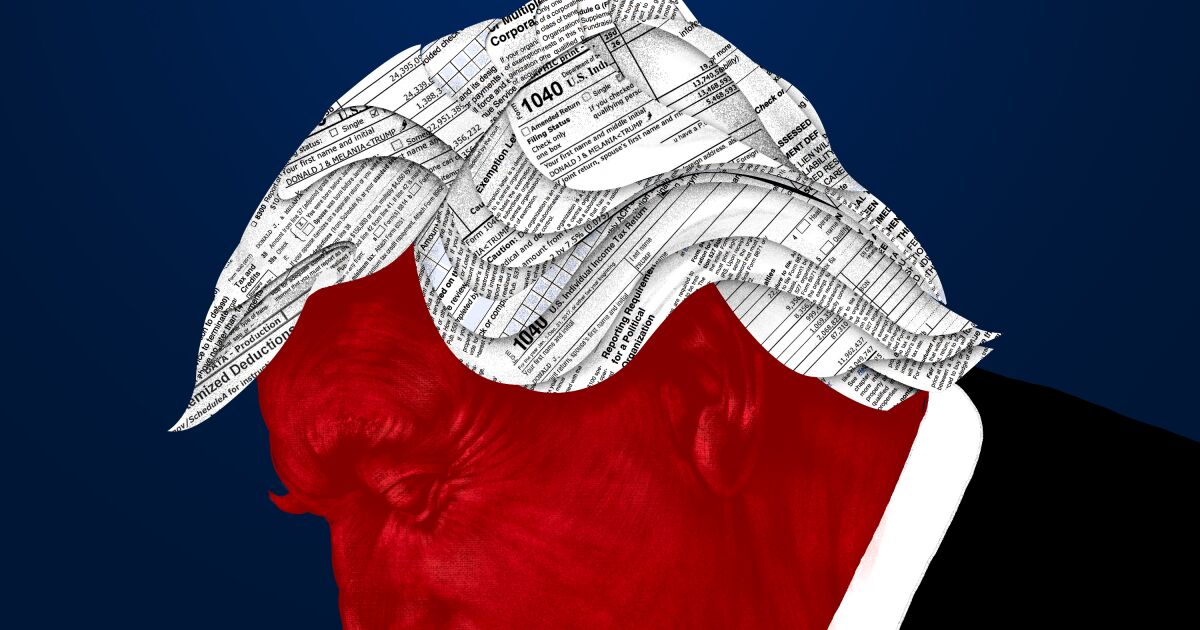
Former President Trump’s seven-year battle to keep the public from seeing his taxes ended in defeat Friday as a House committee released six years of returns documenting his aggressive efforts to minimize what he paid the IRS.
Trump and his wife, Melania, paid $750 or less in federal income tax in 2016 and 2017. The couple paid zero taxes in 2020 and claimed a $5.5-million refund, according to the returns released by the House Ways and Means Committee, which oversees tax legislation.
In three other years, Trump paid significant amounts of taxes. As a share of his income, however, his payments were far below those of the average taxpayer. The returns show he paid $641,931 in 2015, just under $1 million in 2018 and $133,445 in 2019.
The 2018 payment came on reported adjusted gross income of $24.3 million — an effective tax rate of 4%. By contrast, the average taxpayer in 2018 paid $15,322 in federal income taxes, with an average rate of about 13%, according to the IRS.
Since 1977, the IRS has had a stated policy of mandatory audits of the tax returns of presidents and vice presidents. But in obtaining Trump’s returns, House Democrats discovered that during the first two years of Trump’s term, the IRS had not audited the president.
For the record:
7:51 a.m. Dec. 30, 2022An earlier version of this article incorrectly stated which year’s tax return from former President Trump the Ways and Means Committee says the IRS did not begin auditing until April 2019. It is the 2015 return.
When the agency finally did so, it didn’t dedicate enough resources to fully answer questions about Trump’s claims, the committee suggested. The IRS did not begin auditing Trump’s 2015 return until April 3, 2019, the day that the chairman of the tax-writing committee, Rep. Richard E. Neal (D-Mass.), sent the IRS a written inquiry, the panel said. The IRS disputed that, saying it began the audit the previous year.
The release of the returns — redacted to hide Social Security numbers and other private information — marked the final act of a saga that outlasted Trump’s presidency and included two trips to the Supreme Court as Trump resisted public disclosure of his financial records. It came in the final days of Democratic control of the House.
“The Democrats should have never done it, the Supreme Court should have never approved it, and it’s going to lead to horrible things for so many people,” Trump said in a statement tweeted by his spokesperson. “The great USA divide will now grow far worse.”
The latest disclosures raise multiple questions about whether Trump’s tax strategies simply took advantage of the law or broke it. Republicans, who denounced the release of the returns as a violation of Trump’s privacy, are unlikely to inquire further once they take over the Ways and Means Committee in January. But in the Senate, where the Democrats continue to have a majority, leaders of the Finance Committee have indicated they may pick up where the House Democrats left off.
During the years in which Trump battled disclosure, much of the information he sought to keep secret about his pre-presidential finances became public anyway, largely from a 2020 New York Times investigation.
The picture that emerged showed that for all Trump’s claims to be a great businessman, his core businesses — a sprawling network of hotels, golf courses and other properties — have lost millions of dollars year after year.
“He’s a staggering loser,” said Steven M. Rosenthal, a senior fellow in the Urban-Brookings Tax Policy Center.
The newly released records, covering 2015-20, add to that picture and supply some important new details:
In his final year in office, Trump appears to have reneged on his pledge to donate his $400,000 annual salary as president to charity.
“I am totally giving up my salary if I become president,” he said during the 2016 campaign, and early in his presidency, his aides released details on where Trump had donated the money.
But his 2020 return shows zero charitable contributions. His 2018 and 2019 returns reported charitable contributions of just over $500,000. In 2017, he reported giving $1.9 million to charity. In a report on Trump’s taxes, the committee noted that Trump provided little documentation to back up those claimed contributions, a potential red flag for auditors.
Trump’s golf courses in the U.S. and Scotland have been consistent money losers, the returns show. His hotel properties, by contrast, were very profitable in 2017, the first year of his presidency, but experienced very large losses in 2020, thanks at least in part to the COVID-19 pandemic, which devastated the hospitality industry.
Foreign income was a major boost for Trump. In 2017, his gross income from foreign sources totaled $55.4 million. That included $6.5 million from business in China, where he made a state visit that year. He had reported no income from China in 2016. The 2017 return also showed $5.7 million in income from India. Most of the rest of the foreign income that year came from Canada.
The returns do not appear to disclose any nefarious sources of income — contrary to speculation over the years by some of Trump’s opponents.
Although many of his business ventures operated at a loss, Trump received a large amount of income for years from his reality television show, “The Apprentice,” and from other efforts to license his name. That income had declined by the time he ran for president, but Trump also received steady income from a real estate partnership in which he has a partial ownership interest, but no management authority.
Trump continued to benefit heavily from inherited wealth. Trump’s big tax bill in 2018 — by far the largest payment during his presidency — involved proceeds from the sale of property that he and his siblings inherited from their father, Fred Trump, including more than $14 million from the sale of Starrett City, a huge housing complex in Brooklyn that the senior Trump built.
The IRS is continuing to audit Trump’s returns and has not resolved some questions that pre-date his presidency. If the agency rules against Trump, he could face millions of dollars in additional tax liability.
It’s less likely that the former president would face criminal liability related to his taxes — the Manhattan district attorney’s office, which subpoenaed Trump’s tax returns, received them in 2018 and has brought no charges against him. The office did bring a tax fraud case against the Trump Organization, the family real estate firm, that resulted in a conviction in early December.
One question the returns do not resolve is Trump’s net worth. As a presidential candidate in 2016, Trump claimed to be worth as much as $9 billion. Forbes magazine, which estimates the size of America’s largest fortunes, said that was grossly exaggerated. This year, the magazine valued Trump’s fortune at $3.2 billion. Trump has paid a lot less in taxes than other top billionaires, studies have found.
As Rosenthal and others point out, it’s not clear how much of the negative income reported by Trump on his tax forms can be attributed to actual business losses as opposed to aggressive use of tax rules.
One widely used strategy that Trump took extensive advantage of involves carrying over losses from one year to reduce tax liability in another. In 2015, for example, Trump carried over an operating loss of $105.2 million. The source of his carryover losses from 2015-18 is thought to be a $700-million loss posted by Trump in 2009. In its report, the House committee noted that these carryover losses need to be verified, and there are indications that the IRS may still be looking at whether the massive 2009 loss was valid.
Trump’s ability to zero out his tax liability highlights the extremely favorable treatment the real estate industry receives under tax law as well as strategies that he and other wealthy individuals use to minimize what they must pay.
Beyond the carryover losses, the returns also show a pattern of questionable claims, the committee report noted.
In addition to the charitable deductions, those include large business-expense deductions that in some cases lack documentation; financial transactions with three of his children, Ivanka, Donald Jr. and Eric, that the committee report said may have been “disguised gifts”; and millions of dollars in write-offs related to an estate that Trump owns in the New York suburbs. He initially claimed the estate, known as Seven Springs, as a personal residence, then reclassified it as a business investment in 2014.
The documents released Friday indicate that the IRS is investigating the write-offs Trump took at Seven Springs, and that the agency has questioned whether Trump may have used an inflated appraisal to bolster his claim.
The tax returns show a number of other cases, small and large, that were flagged by congressional staff. In one schedule for the 2015 tax year, Trump reported a $50,000 speaking fee that was almost entirely offset by $46,162 in claimed travel expenses.
In 2017, the year Trump paid a net tax of $750, his return shows he took $7.4 million in tax credits, which completely erased the tax he otherwise would have owed. Some of those tax credits were apparently for renovating the Trump International Hotel in Washington, D.C., which he sold after leaving office. Tax law provides for credit for investments in historic properties and for certain poor communities, but the IRS has not yet determined whether Trump’s claims were valid.
In releasing the documents, Democrats pointed to what they described as the IRS’ failure to put enough resources into auditing Trump as evidence of possible political interference with the tax agency during Trump’s presidency.
“We anticipated the IRS would expand the mandatory audit program to account for the complex nature of the former president’s financial situation yet found no evidence of that. This is a major failure of the IRS under the prior administration, and certainly not what we had hoped to find,” Neal said in a written statement on Friday.
House Republicans, who will take control of the chamber next week, denounced the release of Trump’s taxes as a violation of his privacy and a dangerous precedent.
“This is a regrettable stain on the Ways and Means Committee and Congress, and will make American politics even more divisive and disheartening,” Rep. Kevin Brady (R-Texas), the senior Republican on the panel, said in a statement. “In the long run, Democrats will come to regret it.”
Democrats also argued that the IRS’ failure to consistently audit Trump highlighted the agency’s lack of resources to go up against wealthy taxpayers and the lawyers and accounting firms they can hire.
Some of the delay may be due to the complexity of Trump’s businesses, with multi-tiered partnerships and so-called S corporations in which the entities pass corporate income, losses, deductions and credits through to shareholders.
Over the last 10 years, the IRS had the capacity to audit just one partnership with 100 or more partners in a year, said Richard Prisinzano, a former veteran of the Treasury Department’s Office of Tax Analysis who is now at Penn Wharton Budget Model, a think tank.
“I think the IRS is outgunned on this stuff,” he said.
At the Biden administration’s request, Congress this year approved a major increase in funds for the IRS, $80 billion over 10 years, mostly to improve its ability to audit wealthy taxpayers.
As a candidate and then as president, Trump repeatedly used the claim about being under audit to fend off demands that he release copies of his returns. Every president and major-party candidate dating back to President Carter has voluntarily released their tax returns.
Before formally announcing his run for the presidency in June 2015, Trump said he would release his taxes. But he soon began hedging and deflecting, and in February 2016, during a televised debate, settled on the claim that “I can’t do it until the audit is finished,” which he stuck to for the remainder of the campaign. Tax-law experts have repeatedly said that nothing in the audit process prevents a person from releasing copies of returns.
Trump’s effort to keep his taxes secret began to crumble after Democrats regained control of the House in the 2018 midterm elections. A federal law dating to 1924 allows the congressional tax-writing committees to obtain copies of any individual’s tax returns — a seldom-used power, but one that provided Democrats with an opening to demand Trump’s information.
When the Ways and Means Committee asked for Trump’s returns in 2019, Treasury Secretary Steven T. Mnuchin refused, setting off a court fight that stretched across more than three years as Trump sought to block the disclosure.
A year ago, U.S. District Judge Trevor N. McFadden, a Trump appointee, ruled against the former president. In August, a federal appeals court in Washington also sided with Congress, saying that the Ways and Means panel had a valid legislative purpose in seeking to know how the IRS was handling Trump’s returns and that the disclosure of the tax information was not overly burdensome on Trump. The Supreme Court in November refused to review that ruling.
“Every president takes office knowing that he will be subject to the same laws as all other citizens upon leaving office,” the appeals court panel wrote. “This is a feature of our democratic republic, not a bug.”
#Children
Published on The Perfect Enemy at https://bit.ly/3IifhZM.
Comments
Post a Comment
Comments are moderated.